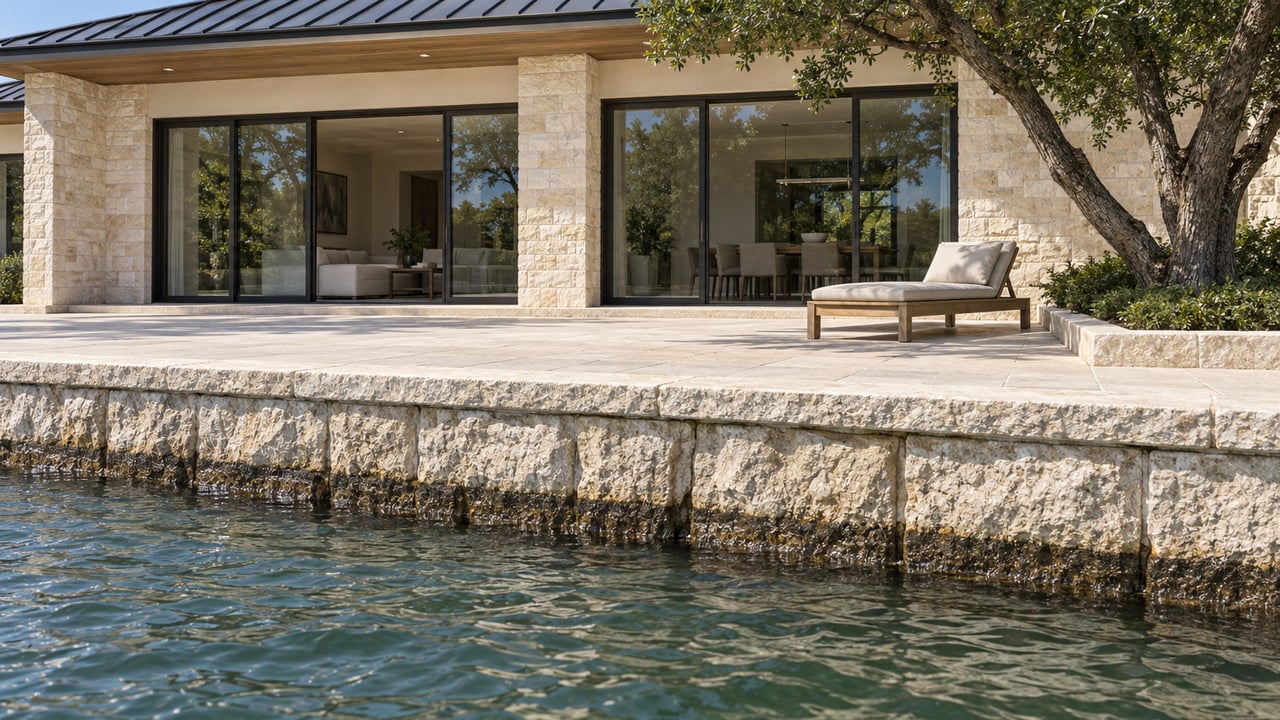
Lake Travis crossed full pool in mid-July 2026, the first time it has done so since 2019. The lake looks the way longtime boaters remember it, and buyers who spent the drought years watching mudflats spread across their favorite coves are back in showings. At the same time, the surrounding market is soft: median days on market for waterfront in Lakeway sat at 121 in the most recent update from local brokerage data, and roughly two-thirds of Lakeway listings have taken at least one price cut.
Those two facts do not contradict each other. They point to something a full-pool photograph cannot show. What a Lake Travis dollar buys in 2026 is not determined by water level or square footage. It is determined by four questions the listing page never asks.
The thesis, plainly
Waterfront on Lake Travis is priced off transferability, not view. Two homes on the same cove, at the same elevation, with identical finishes, can trade at meaningfully different numbers because one of them can convey a working dock to the next owner and the other cannot. In a full-pool, high-inventory market, buyers finally have time to sort out which is which, and the listings that fail one of the four tests are the ones sitting longest and cutting price hardest.
Four questions the MLS photo doesn't answer
The Lower Colorado River Authority regulates almost everything that happens between the shoreline and the water. Local jurisdictions layer on top. None of it appears in the price per square foot.
1. Does the seller actually own the lakebed?
Owning waterfront property does not automatically mean owning the submerged land under your dock. Most Highland Lakes shoreline owners do, but not all. Where the lakebed is LCRA-owned, the dock sits under a revocable license rather than a permit, and that distinction matters at closing. A buyer who assumes the dock is theirs may inherit an annual license that requires a fresh agreement with the licensing authority in their own name.
The Travis County Water Control and Improvement District No. 17, which governs a stretch of the Lakeway shoreline, is explicit about this: its dock licenses are personal and not transferable. Any change of ownership requires the new buyer to execute a new license agreement with the district. LCRA Real Estate Services can be reached at 800-776-5272 for submerged-land questions, and that call is worth making before an inspection period closes, not after.
2. Does the dock convey in working order?
LCRA classifies a dock as dilapidated if any structural members are not securely attached, if the deck is submerged, or if it is otherwise in a state of disrepair. Dilapidated docks are not allowed on the Highland Lakes, which means a buyer who accepts a marginal dock at closing may be accepting a future notice of violation.
Residential docks under 1,500 square feet of water surface area do not require a formal LCRA permit, but they must still meet the Safety Standards for Residential Docks on the Highland Lakes governing flotation, lighting, anchoring, and maximum distance from shore. Docks larger than 1,500 square feet fall under the Highland Lakes Marina Ordinance, updated by the LCRA Board on May 24, 2023. That update also banned the creation of new community marinas, which is a quiet supply constraint any buyer relying on shared water access should understand before signing.
3. Can the cove hold the dock you actually want?
Cove geometry is destiny. LCRA safety standards require an additional 40 feet of lake access beyond a proposed dock; if a cove is narrower than 40 feet including any existing dock on the opposite shore, only recessed docks are permitted. Maximum distance from shore is measured from the current shoreline, not a fixed benchmark, so drought years can push a compliant dock into non-compliance without the owner touching it.
For buyers moving between listings, this is the single most under-priced variable. Open-water frontage in Lakeway and Hudson Bend starts around $1.5M in 2026 pricing, while cove lots in Lago Vista and Point Venture open in the high $600Ks. Some of that gap is view. A lot of it is the dock the cove will physically allow.
4. Where do the 715-foot and 722-foot lines fall on the survey?
Two elevations govern what can be built and financed on a lakefront parcel. Full pool sits at 681 feet above mean sea level. The LCRA's flowage and conservation easement typically extends up to 715 feet, or 34 feet above full pool, and anything placed inside that band, including bulkheads and retaining walls, falls under LCRA jurisdiction. The updated Lake Travis floodplain maps then move the flood insurance and building elevation threshold from the older 715-foot line to 722 feet.
The consequences are practical. A home whose primary structure sits below 723 feet may be built in the floodplain, with insurance and lender implications a portal listing will not flag. Zone AE, the 1% annual chance zone, requires flood insurance on federally backed mortgages. Most shoreline and lower-elevation lots fall at least partially inside it. An elevation certificate is the document that settles this, and requesting one during option is usually cheaper than assuming.
What full pool actually changes
Every six-foot drop in Lake Travis levels correlates with roughly a 3.5% decline in waterfront values, according to research cited by local waterfront specialists. That number is a useful anchor for the reverse move now underway. Between drought lows and July 2026's return to 681 feet, functional dock access has been restored across coves that were mudflats for years, and the marketing photographs are finally accurate.
What it does not change is the transferability question. A dock that was moved to follow receding water during the drought may now sit in a spot that no longer complies with maximum-distance-from-shore rules at full pool, or may have been re-anchored over submerged land the current owner does not control. The rise reveals problems as often as it solves them.
On Lake Travis, water level is the story sellers want to tell. Permit status, submerged-land ownership, cove geometry, and elevation are the story buyers need to hear before they price the offer.
Reading the price gap between open water and cove
The luxury tier above $1M has behaved differently from the broader market. Limited supply of premium waterfront, defined by deep-water main-body access, private docks in compliant configurations, and elevated primary structures, has driven 8 to 10% appreciation in select pockets even as the broader Lake Travis area corrected. Waterford on Lake Travis, a cove community in Point Venture, saw its median sale price reach $510,000 in March 2026, up 4.8% year over year, with days on market compressing from 188 to 64.
That divergence is not random. It rewards the properties that can answer all four transferability questions cleanly and penalizes those that cannot. In a market with 5 to 6 months of inventory, buyers have the leverage to insist on the answers.
Where the softness gives buyers real leverage
The broader Lake Travis area, encompassing Lakeway, Bee Cave, and Lago Vista, is now averaging 60 to 80 days on market with a sale-to-list ratio around 96%, according to figures compiled by local brokerages using ABoR data through mid-2026. Lakeway waterfront specifically sits at 121 median days on market, and the sale-to-list ratio there has softened to 92.35%. Seller concessions, rate buydowns, and repair credits are now normal negotiation items rather than exceptions.
The new-supply pressure is worth naming. Travis Club, a 1,500-acre development in Spicewood with a Beau Welling championship course opening mid-2026 and a private marina, is bringing homesites priced from $700,000 to $3.4 million into the same buyer pool. That is the first new luxury lakefront community of scale in years, and it is drawing decision time away from resale inventory that cannot compete on amenity or certainty.
A short FAQ
If the seller cannot produce an LCRA permit letter for the dock, is that a deal breaker? Not necessarily. Many compliant residential docks under 1,500 square feet operate without a formal permit but must still meet LCRA safety standards. What matters is confirming, in writing, whether the submerged land is privately owned or LCRA-managed, and whether any existing license transfers. If the paperwork does not exist, price the risk of remediation into the offer.
Does the July 2026 full pool mean waterfront prices will jump? The historical pattern from the 2011 to 2014 drought suggests recovery lags the water. Values remained 20 to 40% below pre-drought peaks through 2017, several years after levels normalized. Full pool restores marketing appeal and functional access, which supports pricing, but it does not on its own erase the current inventory overhang.
Is a cove lot a worse investment than open-water frontage? It is a different investment. Cove lots protect boats from wind and chop and offer lower entry prices. Open-water lots offer views and dock configurations that coves geometrically cannot. The right answer depends on how the buyer will actually use the water, and on which lots have the permit history to prove what can be built.
Working the decision
A Lake Travis waterfront purchase in 2026 is not a race. It is a document review with a boat included. Contact Thomas Luxury Group to request a private consultation on a specific parcel, including submerged-land verification, dock permit history, elevation certificate review, and a discreet look at off-market lakefront inventory through the Compass Private Exclusives network.